

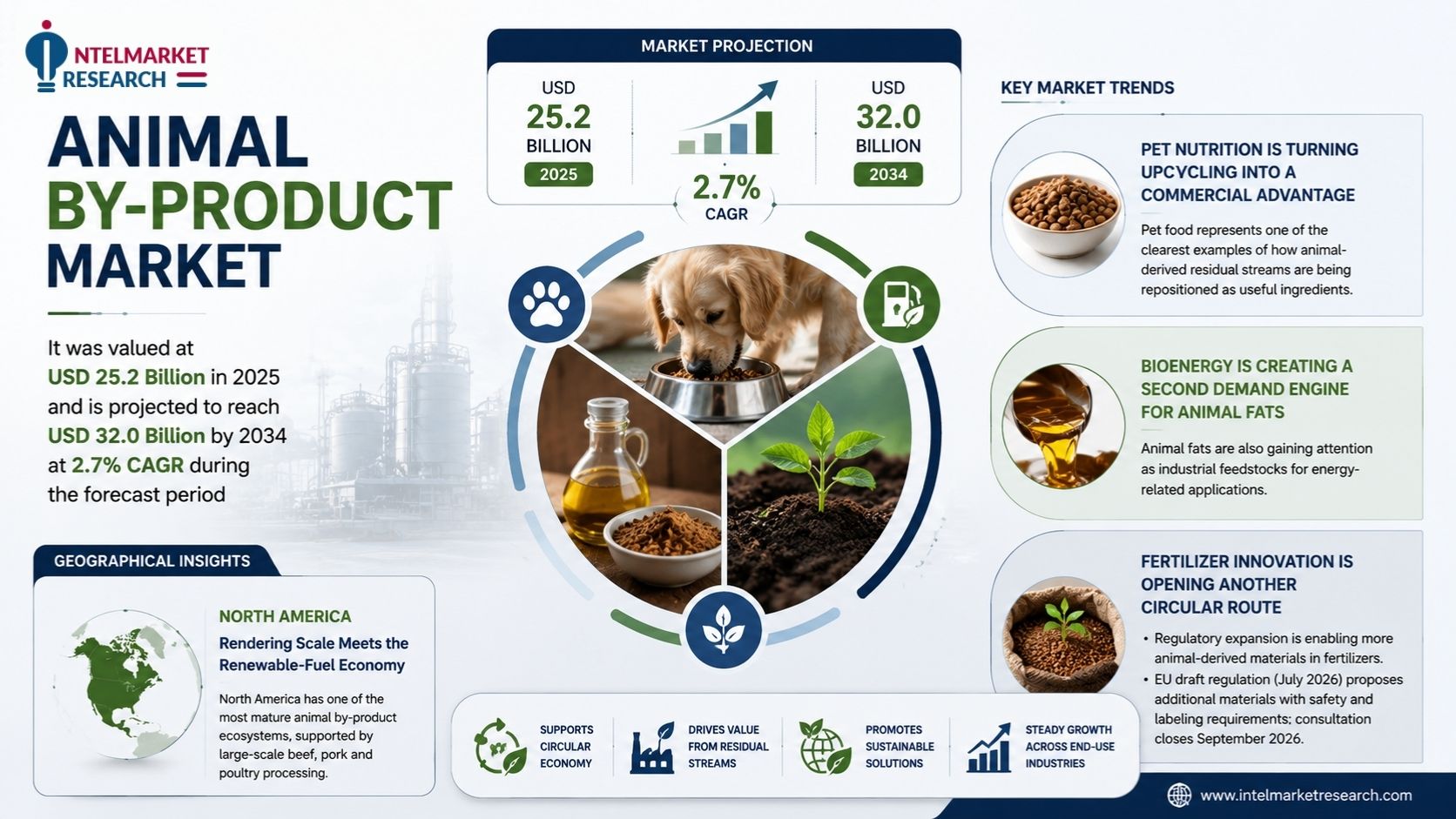
Animal By-product Market to Reach USD 32.0 Billion by 2034, Advancing at 2.7% CAGR: Driven by Resource Recovery
Animal by-product Market Report
Animal By-product Market will rise from USD 25.2 Bn in 2025 to USD 32.0 Bn by 2034 at 2.7% CAGR, supported by rising demand for animal-derived products.
Traceability, higher-value uses, and more intelligent conversion technologies will characterise the next stage of animal by-product utilisation.”
PUNE, MAHARASHTRA, INDIA, August 28, 2026 /EINPresswire.com/ -- Animal By-Product Market is entering a more sophisticated phase as industries rethink what happens to animal-derived materials that are not destined for direct human consumption. Bones, blood, fat, offal, hides, feathers, shells, manure and former food products are increasingly being treated as recoverable resources rather than simple waste streams.— IntelMarketResearch
The scale is substantial. The European Commission estimates that more than 20 million tonnes of animal by-products are generated annually in the European Union from slaughterhouses, food-processing facilities, dairies and fallen stock. These materials can present biological risks if poorly handled, but they also contain valuable nutritional, energetic and functional components.
This is changing the strategic role of rendering plants, collection networks, processors and downstream manufacturers. Instead of operating solely around disposal, the sector is increasingly organized around resource recovery, product quality, traceability and end-use diversification.
𝐓𝐡𝐞 𝐍𝐞𝐰 𝐕𝐚𝐥𝐮𝐞 𝐂𝐡𝐚𝐢𝐧 𝐈𝐬 𝐁𝐞𝐢𝐧𝐠 𝐁𝐮𝐢𝐥𝐭 𝐀𝐫𝐨𝐮𝐧𝐝 𝐌𝐮𝐥𝐭𝐢𝐩𝐥𝐞 𝐄𝐧𝐝 𝐌𝐚𝐫𝐤𝐞𝐭𝐬
• The modern animal by-product ecosystem is no longer dependent on one application.
• Rendered fats can enter oleochemical and energy pathways, while processed proteins can support selected feed and pet-food applications.
• Other derived materials can move into fertilizers, cosmetics, pharmaceuticals, technical products and biomaterials.
• The European Commission specifically recognizes end-use pathways involving fertilizers, pet food, biofuels, textiles, cosmetics and pharmaceuticals.
• Its regulatory framework also provides for defined “end points,” where certain derived products cease to be regulated as animal by-products once they meet specified safety conditions.
•This creates an important commercial opportunity: processors can increasingly focus on producing application-specific ingredients rather than undifferentiated bulk outputs.
💠𝐓𝐚𝐤𝐞 𝐚 𝐦𝐨𝐦𝐞𝐧𝐭 𝐭𝐨 𝐜𝐡𝐞𝐜𝐤 𝐨𝐮𝐫 𝐥𝐚𝐭𝐞𝐬𝐭 𝐬𝐚𝐦𝐩𝐥𝐞 𝐫𝐞𝐩𝐨𝐫𝐭 𝐛𝐞𝐟𝐨𝐫𝐞 𝐦𝐨𝐯𝐢𝐧𝐠 𝐟𝐨𝐫𝐰𝐚𝐫𝐝: https://www.intelmarketresearch.com/download-free-sample/11401/animal-by-product-market
𝐑𝐞𝐧𝐝𝐞𝐫𝐢𝐧𝐠 𝐈𝐬 𝐁𝐞𝐢𝐧𝐠 𝐑𝐞𝐩𝐨𝐬𝐢𝐭𝐢𝐨𝐧𝐞𝐝 𝐚𝐬 𝐚 𝐂𝐢𝐫𝐜𝐮𝐥𝐚𝐫 𝐌𝐚𝐧𝐮𝐟𝐚𝐜𝐭𝐮𝐫𝐢𝐧𝐠 𝐏𝐥𝐚𝐭𝐟𝐨𝐫𝐦
Rendering remains one of the industry's most important conversion technologies, but its role is evolving. Traditional rendering converts animal tissues into stable fats and protein-rich materials. Newer business strategies increasingly emphasize resource efficiency, controlled processing, and traceability and higher-value downstream products.
Historical FAO material estimated that the global rendering industry processed roughly 60 million tonnes of animal by-products annually, illustrating the enormous physical scale of the resource stream. The same material noted that slaughter and processing can remove approximately 33% to 43% of live-animal weight as materials such as fat trim, viscera, bone, blood and feathers.
Today, the opportunity is not simply to process larger volumes. It is to extract more value from each tonne through better separation, quality control and targeted end-use development.
𝐒𝐞𝐠𝐦𝐞𝐧𝐭𝐚𝐭𝐢𝐨𝐧 𝐀𝐧𝐚𝐥𝐲𝐬𝐢𝐬
➣ 𝐓𝐲𝐩𝐞
• Meat and Bone Meal (Market-Leading Protein Stream)
• Feather Meal
• Blood Meal
• Animal Fats
𝗞𝗲𝘆 𝗶𝗻𝘀𝗶𝗴𝗵𝘁: Meat and bone meal leads due to its broad availability, concentrated protein content and cost advantage in permitted animal nutrition applications.
➣ 𝐀𝐩𝐩𝐥𝐢𝐜𝐚𝐭𝐢𝐨𝐧
• Animal Feed (Largest Application Base)
• Pet Food
• Fuel
• Others
𝗞𝗲𝘆 𝗶𝗻𝘀𝗶𝗴𝗵𝘁: Animal feed remains the largest outlet as livestock and poultry producers seek economical protein ingredients with strong nutritional value.
➣ 𝐏𝐫𝐨𝐜𝐞𝐬𝐬𝐢𝐧𝐠 𝐌𝐞𝐭𝐡𝐨𝐝
• Rendering (Established Processing Standard)
• Hydrolysis
• Extraction
𝗞𝗲𝘆 𝗶𝗻𝘀𝗶𝗴𝗵𝘁: Rendering remains dominant because it efficiently converts large volumes of animal residues into commercially valuable protein meals and fats.
➣ 𝐃𝐢𝐬𝐭𝐫𝐢𝐛𝐮𝐭𝐢𝐨𝐧 𝐂𝐡𝐚𝐧𝐧𝐞𝐥
• Direct Sales (Preferred Bulk Procurement Channel)
• Distributors
• Online Platforms
𝗞𝗲𝘆 𝗶𝗻𝘀𝗶𝗴𝗵𝘁: Direct sales lead as large-volume buyers prefer long-term supply agreements, consistent specifications and closer coordination with rendering companies.
➣ 𝐄𝐧𝐝 𝐔𝐬𝐞𝐫
• Livestock Producers (Primary Demand Base)
• Pet Food Manufacturers
• Biofuel Producers
𝗞𝗲𝘆 𝗶𝗻𝘀𝗶𝗴𝗵𝘁: Livestock producers account for the strongest traditional demand because rendered protein ingredients support cost-efficient and nutritionally balanced feed formulations.
𝐏𝐞𝐭 𝐍𝐮𝐭𝐫𝐢𝐭𝐢𝐨𝐧 𝐈𝐬 𝐓𝐮𝐫𝐧𝐢𝐧𝐠 𝐔𝐩𝐜𝐲𝐜𝐥𝐢𝐧𝐠 𝐢𝐧𝐭𝐨 𝐚 𝐂𝐨𝐦𝐦𝐞𝐫𝐜𝐢𝐚𝐥 𝐀𝐝𝐯𝐚𝐧𝐭𝐚𝐠𝐞
o Pet food represents one of the clearest examples of how animal-derived residual streams are being repositioned as useful ingredients.
o Research highlighted by the North American Renderers Association and industry partners found that U.S. pet food sales reached $51.7 billion in 2024, while approximately 9.8 million tons of pet food were produced using more than 600 ingredients. More than 4 million tons of upcycled ingredients were identified within that production ecosystem.
o The significance goes beyond volume. Pet owners and manufacturers are paying greater attention to ingredient functionality, nutritional density, responsible sourcing and resource efficiency.
o This creates room for carefully processed animal-derived ingredients to participate in premium nutrition strategies when they meet applicable safety and formulation requirements.
💠𝐀𝐜𝐜𝐞𝐬𝐬 𝐭𝐡𝐞 𝐋𝐚𝐭𝐞𝐬𝐭 𝐂𝐚𝐭𝐞𝐠𝐨𝐫𝐲 𝐈𝐧𝐬𝐢𝐠𝐡𝐭𝐬 𝐟𝐫𝐨𝐦 𝐎𝐮𝐫 𝐍𝐞𝐰𝐥𝐲 𝐑𝐞𝐥𝐞𝐚𝐬𝐞𝐝 𝐒𝐭𝐮𝐝𝐲: https://www.intelmarketresearch.com/animal-by-product-market-11401
𝐁𝐢𝐨𝐞𝐧𝐞𝐫𝐠𝐲 𝐈𝐬 𝐂𝐫𝐞𝐚𝐭𝐢𝐧𝐠 𝐚 𝐒𝐞𝐜𝐨𝐧𝐝 𝐃𝐞𝐦𝐚𝐧𝐝 𝐄𝐧𝐠𝐢𝐧𝐞 𝐟𝐨𝐫 𝐀𝐧𝐢𝐦𝐚𝐥 𝐅𝐚𝐭𝐬
Animal fats are also gaining attention as industrial feedstocks for energy-related applications. Instead of remaining confined to traditional uses, suitable fats can enter pathways associated with biodiesel and other renewable-energy products.
The European regulatory framework already recognizes processed animal by-products in connection with biofuels and provides mechanisms for certain derived products to reach regulatory end points.
This is particularly important as manufacturers and fuel producers evaluate alternative feedstocks. The strategic question is shifting from “How can this material be disposed of?” to “Which downstream pathway generates the highest safe and compliant value?”
𝐅𝐞𝐫𝐭𝐢𝐥𝐢𝐳𝐞𝐫 𝐈𝐧𝐧𝐨𝐯𝐚𝐭𝐢𝐨𝐧 𝐈𝐬 𝐎𝐩𝐞𝐧𝐢𝐧𝐠 𝐚𝐧𝐨𝐭𝐡𝐞𝐫 𝐂𝐢𝐫𝐜𝐮𝐥𝐚𝐫 𝐑𝐨𝐮𝐭𝐞
A particularly relevant 2026 development is the continued regulatory expansion around the use of animal-derived materials in fertilizers.
➣ In July 2026, the European Commission notified a draft delegated regulation proposing additional derived animal-by-product materials as component materials in EU fertilising products.
➣ The proposal is linked to materials for which an end point had already been established and includes requirements related to safety and labeling. The consultation deadline is September 2026.
This direction reinforces the wider circular-economy model in which nutrients recovered from animal processing can return to agricultural systems rather than being permanently lost from the resource cycle.
💠𝐑𝐞𝐪𝐮𝐞𝐬𝐭 𝐲𝐨𝐮𝐫 𝐅𝐫𝐞𝐞 𝐒𝐚𝐦𝐩𝐥𝐞 𝐑𝐞𝐩𝐨𝐫𝐭 𝐜𝐨𝐩𝐲: https://www.intelmarketresearch.com/download-free-sample/11401/animal-by-product-market
𝐑𝐞𝐠𝐮𝐥𝐚𝐭𝐢𝐨𝐧 𝐈𝐬 𝐁𝐞𝐜𝐨𝐦𝐢𝐧𝐠 𝐚 𝐌𝐚𝐫𝐤𝐞𝐭 𝐃𝐢𝐟𝐟𝐞𝐫𝐞𝐧𝐭𝐢𝐚𝐭𝐨𝐫
The competitive landscape is increasingly shaped by regulatory capability as much as processing capacity.
EU rules require safe sourcing, treatment, traceability and controlled end uses for animal by-products. In Great Britain, the regulatory environment is similarly active. The government updated its list of approved animal-by-product operating plants in August 2026, following additional updates in February, March, and April, May, June and July.
Such frequent regulatory and establishment updates demonstrate how closely the sector is connected with biosecurity, food safety, trade documentation and environmental controls.
For companies, compliance is therefore becoming part of the value proposition. A processor capable of documenting origin, category, treatment, movement and final application can be better positioned for sophisticated supply chains than one competing solely on processing cost.
𝐀𝐥𝐭𝐞𝐫𝐧𝐚𝐭𝐢𝐯𝐞 𝐏𝐫𝐨𝐜𝐞𝐬𝐬𝐢𝐧𝐠 𝐓𝐞𝐜𝐡𝐧𝐨𝐥𝐨𝐠𝐢𝐞𝐬 𝐂𝐨𝐮𝐥𝐝 𝐑𝐞𝐝𝐞𝐟𝐢𝐧𝐞 𝐭𝐡𝐞 𝐍𝐞𝐱𝐭 𝐆𝐫𝐨𝐰𝐭𝐡 𝐂𝐲𝐜𝐥𝐞
• Technology development is another emerging differentiator. The European Food Safety Authority continues to maintain guidance and application pathways for alternative processing methods for animal by-products, with current regulatory and scientific guidance updated for applicants.
• This creates opportunities for technologies designed to improve material recovery while maintaining biological safety.
• Future development areas may include more precise separation, controlled hydrolysis, improved protein functionality, advanced fat purification, nutrient recovery and specialized conversion processes.
• The most commercially attractive technologies will likely be those capable of combining high recovery rates, consistent output quality, traceability and regulatory acceptance.
𝐓𝐡𝐞 𝐂𝐨𝐦𝐩𝐞𝐭𝐢𝐭𝐢𝐯𝐞 𝐁𝐚𝐭𝐭𝐥𝐞𝐟𝐢𝐞𝐥𝐝 𝐈𝐬 𝐌𝐨𝐯𝐢𝐧𝐠 𝐔𝐩𝐬𝐭𝐫𝐞𝐚𝐦
🔸Darling Ingredients
🔸Valley Proteins
🔸SARIA
🔸Leo Group
🔸Ridley Corporation
🔸FASA Group
🔸Sanimax
🔸JG Pears
🔸Advanced Proteins
🔸Birmingham Hide & Tallow
🔸West Coast Reduction
🔸MOPAC
🔸TerramarChile
🔸Boyer Valley Company
🔸PRODIA SAS
💠𝐆𝐞𝐭 𝐈𝐧𝐬𝐭𝐚𝐧𝐭 𝐀𝐜𝐜𝐞𝐬𝐬 𝐭𝐨 𝐎𝐮𝐫 𝐋𝐚𝐭𝐞𝐬𝐭 𝐑𝐞𝐬𝐞𝐚𝐫𝐜𝐡 𝐏𝐃𝐅 𝐒𝐚𝐦𝐩𝐥𝐞 𝐁𝐫𝐨𝐜𝐡𝐮𝐫𝐞: https://www.intelmarketresearch.com/download-free-sample/11401/animal-by-product-market
𝐆𝐞𝐨𝐠𝐫𝐚𝐩𝐡𝐢𝐜𝐚𝐥 𝐈𝐧𝐬𝐢𝐠𝐡𝐭𝐬
◾𝐍𝐨𝐫𝐭𝐡 𝐀𝐦𝐞𝐫𝐢𝐜𝐚 | 𝐑𝐞𝐧𝐝𝐞𝐫𝐢𝐧𝐠 𝐒𝐜𝐚𝐥𝐞 𝐌𝐞𝐞𝐭𝐬 𝐭𝐡𝐞 𝐑𝐞𝐧𝐞𝐰𝐚𝐛𝐥𝐞-𝐅𝐮𝐞𝐥 𝐄𝐜𝐨𝐧𝐨𝐦𝐲
North America has one of the most mature animal by-product ecosystems, supported by large-scale beef, pork and poultry processing. The United States has an established rendering network that converts animal residues into protein meals, fats and specialty ingredients, while the expansion of renewable diesel is creating an additional outlet for rendered fats.
The U.S. Energy Information Administration has highlighted the rapid expansion of renewable diesel production capacity, increasing competition for feedstocks including animal fats and used cooking oils.
𝗪𝗵𝗮𝘁 𝗶𝘀 𝗰𝗵𝗮𝗻𝗴𝗶𝗻𝗴 𝗼𝗻 𝘁𝗵𝗲 𝗴𝗿𝗼𝘂𝗻𝗱?
• Rendered fats are gaining importance as renewable-fuel feedstocks.
• Large processors are focusing on higher recovery rates from slaughterhouse residues.
• Established rendering infrastructure provides strong collection and processing advantages.
• Feed, pet nutrition and biofuel markets give producers multiple routes for monetizing recovered materials.
◾𝐄𝐮𝐫𝐨𝐩𝐞 | 𝐑𝐞𝐠𝐮𝐥𝐚𝐭𝐢𝐨𝐧 𝐈𝐬 𝐓𝐮𝐫𝐧𝐢𝐧𝐠 𝐓𝐫𝐚𝐜𝐞𝐚𝐛𝐢𝐥𝐢𝐭𝐲 𝐢𝐧𝐭𝐨 𝐌𝐚𝐫𝐤𝐞𝐭 𝐕𝐚𝐥𝐮𝐞
Europe's animal by-product industry is strongly shaped by regulation. The European Union categorizes animal by-products according to risk and establishes specific requirements for their collection, processing, movement and permitted end uses.
This regulatory structure is encouraging companies to invest in segregation, traceability, controlled processing and documented end-use pathways. Rather than treating compliance purely as an operating requirement, processors are increasingly using quality and traceability to differentiate their products.
𝗥𝗲𝗴𝗶𝗼𝗻𝗮𝗹 𝘀𝗶𝗴𝗻𝗮𝗹𝘀 𝘁𝗼 𝘄𝗮𝘁𝗰𝗵:
• Greater emphasis on documented sourcing and material classification.
• Continued development of animal-derived fertilizers and soil improvers.
• Growing integration between rendering and circular-economy initiatives.
• Opportunities for processed fats in renewable-energy applications.
◾𝐀𝐬𝐢𝐚 𝐏𝐚𝐜𝐢𝐟𝐢𝐜 | 𝐭𝐡𝐞 𝐑𝐞𝐠𝐢𝐨𝐧 𝐖𝐡𝐞𝐫𝐞 𝐒𝐮𝐩𝐩𝐥𝐲 𝐚𝐧𝐝 𝐃𝐞𝐦𝐚𝐧𝐝 𝐌𝐞𝐞𝐭 𝐚𝐭 𝐒𝐜𝐚𝐥𝐞
Asia Pacific presents a particularly interesting dynamic because major livestock and poultry production centers sit alongside large feed-consuming markets.
China, India, Japan, Australia and Southeast Asia contribute differently to the value chain. China and several Southeast Asian economies provide substantial feed demand, while Australia and other livestock-producing markets generate significant quantities of recoverable animal material.
The region's expanding food-processing infrastructure is also creating opportunities to modernize collection and rendering systems.
𝗠𝗮𝗿𝗸𝗲𝘁 𝘀𝗶𝗴𝗻𝗮𝗹𝘀:
• Rising animal-protein consumption is increasing the underlying raw-material pool.
• Expanding commercial feed production is strengthening demand for recovered proteins.
• Poultry processing is creating additional opportunities for feather and blood meal.
• Modern rendering facilities can improve utilization of materials previously treated as waste.
𝗥𝗲𝗴𝗶𝗼𝗻𝗮𝗹 𝗽𝘂𝗹𝘀𝗲: Asia Pacific's opportunity comes from the powerful combination of large livestock ecosystems, growing feed consumption and expanding resource-recovery infrastructure.
💠𝐆𝐫𝐚𝐛 𝐨𝐮𝐫 𝐫𝐞𝐩𝐨𝐫𝐭 𝐭𝐨 𝐬𝐭𝐚𝐲 𝐢𝐧𝐟𝐨𝐫𝐦𝐞𝐝: https://www.intelmarketresearch.com/animal-by-product-market-11401
◾𝐋𝐚𝐭𝐢𝐧 𝐀𝐦𝐞𝐫𝐢𝐜𝐚 | 𝐌𝐞𝐚𝐭 𝐏𝐫𝐨𝐝𝐮𝐜𝐭𝐢𝐨𝐧 𝐈𝐬 𝐂𝐫𝐞𝐚𝐭𝐢𝐧𝐠 𝐌𝐨𝐫𝐞 𝐌𝐚𝐭𝐞𝐫𝐢𝐚𝐥 𝐭𝐨 𝐌𝐨𝐧𝐞𝐭𝐢𝐳𝐞
Latin America has a natural advantage in animal by-products because of its substantial livestock and meat-processing industries. Brazil is particularly important because of its enormous beef and poultry sectors, while Argentina, Chile and other markets contribute across livestock, poultry and aquaculture.
As meat-processing businesses expand their product portfolios, the residual material generated alongside primary meat production becomes an increasingly valuable secondary revenue stream.
𝗪𝗵𝗲𝗿𝗲 𝗼𝗽𝗽𝗼𝗿𝘁𝘂𝗻𝗶𝘁𝗶𝗲𝘀 𝗮𝗿𝗲 𝗲𝗺𝗲𝗿𝗴𝗶𝗻𝗴:
• Meat and bone meal production linked to large livestock-processing operations.
• Poultry-derived protein ingredients from expanding processing activity.
• Rendered fats for feed and energy applications.
• Greater utilization of processing residues within circular production models.
𝗥𝗲𝗴𝗶𝗼𝗻𝗮𝗹 𝗽𝘂𝗹𝘀𝗲: Latin America is increasingly positioned as a raw-material-rich region where expanding meat exports can simultaneously strengthen the supply of recoverable animal proteins and fats.
◾𝐌𝐢𝐝𝐝𝐥𝐞 𝐄𝐚𝐬𝐭 & 𝐀𝐟𝐫𝐢𝐜𝐚 | 𝐌𝐨𝐝𝐞𝐫𝐧 𝐏𝐫𝐨𝐜𝐞𝐬𝐬𝐢𝐧𝐠 𝐈𝐬 𝐎𝐩𝐞𝐧𝐢𝐧𝐠 𝐚 𝐍𝐞𝐰 𝐑𝐞𝐜𝐨𝐯𝐞𝐫𝐲 𝐎𝐩𝐩𝐨𝐫𝐭𝐮𝐧𝐢𝐭𝐲
The Middle East and Africa currently have less developed rendering infrastructure than the major North American and European markets, but the opportunity is gradually changing as livestock production, poultry processing and organized food systems expand.
Investment in modern slaughtering and processing facilities can create a stronger foundation for collecting and converting animal residues into feed ingredients, fertilizers, fats and other products.
𝐄𝐦𝐞𝐫𝐠𝐢𝐧𝐠 𝐨𝐩𝐩𝐨𝐫𝐭𝐮𝐧𝐢𝐭𝐲 𝐚𝐫𝐞𝐚𝐬:
• Development of localized rendering facilities.
• Better collection and segregation of slaughterhouse residues.
• Growing poultry-processing activity and associated by-product recovery.
• Expansion of livestock and aquaculture feed industries.
𝗥𝗲𝗴𝗶𝗼𝗻𝗮𝗹 𝗽𝘂𝗹𝘀𝗲: The region's opportunity is less about existing rendering scale and more about building modern recovery infrastructure alongside the expansion of organized meat and poultry processing.
𝐖𝐡𝐲 𝐓𝐡𝐢𝐬 𝐌𝐚𝐫𝐤𝐞𝐭 𝐃𝐞𝐬𝐞𝐫𝐯𝐞𝐬 𝐒𝐭𝐫𝐚𝐭𝐞𝐠𝐢𝐜 𝐀𝐭𝐭𝐞𝐧𝐭𝐢𝐨𝐧?
Animal By-Product Market sits at the intersection of food processing, livestock production, environmental management, renewable energy, animal nutrition, agriculture and specialty manufacturing. That positioning gives the sector an unusually broad opportunity base.
Companies that can transform variable biological materials into safe, traceable and specification-driven ingredients are likely to hold an increasingly important role in future circular supply chains.
The competitive advantage will belong not simply to the largest processors, but to organizations that understand where each material can create its highest compliant value.
𝐀 𝐏𝐫𝐚𝐜𝐭𝐢𝐜𝐚𝐥 𝐕𝐢𝐞𝐰 𝐨𝐟 𝐭𝐡𝐞 𝐑𝐞𝐩𝐨𝐫𝐭 𝐒𝐜𝐨𝐩𝐞
This report is designed to move beyond a conventional overview of animal by-products and examine the market as a connected resource-recovery ecosystem. The analysis can support strategic evaluation of rendering operations, processed proteins, animal fats, pet-food ingredients, fertilizer pathways, bioenergy applications, collection infrastructure, regulatory developments, emerging processing technologies and downstream opportunities.
It is intended for manufacturers, processors, investors, technology providers, ingredient companies, food and feed businesses, sustainability teams and other decision-makers seeking to understand where the next commercial opportunities may emerge within the evolving animal by-product value chain.
Rather than viewing animal by-products solely as residual material, the report frames them as feedstocks with multiple potential destinations - and analyzes the technological, regulatory and commercial factors determining which destination creates the greatest value.
💠𝐆𝐚𝐢𝐧 𝐕𝐚𝐥𝐮𝐚𝐛𝐥𝐞 𝐈𝐧𝐬𝐢𝐠𝐡𝐭𝐬 𝐟𝐫𝐨𝐦 𝐎𝐮𝐫 𝐍𝐞𝐰𝐥𝐲 𝐔𝐩𝐝𝐚𝐭𝐞𝐝 𝐑𝐞𝐬𝐞𝐚𝐫𝐜𝐡: https://www.intelmarketresearch.com/animal-by-product-market-11401
💠𝐎𝐮𝐫 𝐅𝐫𝐞𝐞 𝐒𝐚𝐦𝐩𝐥𝐞 𝐑𝐞𝐩𝐨𝐫𝐭 𝐠𝐢𝐯𝐞𝐬 𝐲𝐨𝐮 𝐚 𝐩𝐫𝐞𝐯𝐢𝐞𝐰 𝐨𝐟 𝐭𝐡𝐞 𝐟𝐮𝐥𝐥 𝐬𝐭𝐮𝐝𝐲: https://www.intelmarketresearch.com/download-free-sample/11401/animal-by-product-market
𝐄𝐱𝐩𝐥𝐨𝐫𝐞 𝐨𝐮𝐫 𝐑𝐞𝐥𝐚𝐭𝐞𝐝 𝐑𝐞𝐩𝐨𝐫𝐭𝐬:
➤ 𝗔𝗻𝗶𝗺𝗮𝗹 𝗙𝗲𝗲𝗱 𝗜𝗻𝗴𝗿𝗲𝗱𝗶𝗲𝗻𝘁𝘀 𝗠𝗮𝗿𝗸𝗲𝘁: https://www.intelmarketresearch.com/animal-feed-ingredients-market-29115
➤ 𝗢𝗻𝗹𝗶𝗻𝗲 𝗣𝗲𝘁 𝗙𝗼𝗼𝗱 𝗮𝗻𝗱 𝗦𝘂𝗽𝗽𝗹𝗶𝗲𝘀 𝗠𝗮𝗿𝗸𝗲𝘁: https://www.intelmarketresearch.com/online-pet-foodsupplies-market-market-33542
➤ 𝗣𝗿𝗼𝗰𝗲𝘀𝘀𝗲𝗱 𝗔𝗻𝗶𝗺𝗮𝗹 𝗣𝗿𝗼𝘁𝗲𝗶𝗻𝘀 𝗠𝗮𝗿𝗸𝗲𝘁: https://www.intelmarketresearch.com/processed-animal-proteins-market-9474
➤ 𝗦𝗼𝘆 𝗣𝗿𝗼𝘁𝗲𝗶𝗻 𝗙𝗼𝗿 𝗔𝗻𝗶𝗺𝗮𝗹 𝗙𝗲𝗲𝗱 𝗠𝗮𝗿𝗸𝗲𝘁: https://www.24chemicalresearch.com/reports/269791/global-soy-protein-for-animal-feed-forecast-market
➤ 𝗔𝗻𝗶𝗺𝗮𝗹 𝗙𝗲𝗲𝗱 𝗣𝗿𝗼𝗯𝗶𝗼𝘁𝗶𝗰 𝗕𝗮𝗰𝘁𝗲𝗿𝗶𝗮 𝗠𝗮𝗿𝗸𝗲𝘁: https://www.24chemicalresearch.com/reports/287065/global-animal-feed-probiotic-bacteria-forecast-market
𝐀𝐛𝐨𝐮𝐭 𝐈𝐧𝐭𝐞𝐥 𝐌𝐚𝐫𝐤𝐞𝐭 𝐑𝐞𝐬𝐞𝐚𝐫𝐜𝐡
Intel Market Research is a leading provider of strategic intelligence, offering actionable insights in robotics, automation, and advanced manufacturing technologies. Our research capabilities include:
• Real-time competitive benchmarking
• Global technology innovation monitoring
• Country-specific regulatory and industry analysis
• Over 500+ technology and manufacturing reports annually
Trusted by Fortune 500 companies, our insights empower decision-makers to drive innovation with confidence.
🌐 𝐖𝐞𝐛𝐬𝐢𝐭𝐞: https://www.intelmarketresearch.com
🔗 𝐋𝐢𝐧𝐤𝐞𝐝𝐈𝐧: https://www.linkedin.com/company/intel-market-research
Rohan
IntelMarketResearch
+91 91691 64321
email us here
Visit us on social media:
LinkedIn
Facebook
YouTube
X
Legal Disclaimer:
EIN Presswire provides this news content "as is" without warranty of any kind. We do not accept any responsibility or liability for the accuracy, content, images, videos, licenses, completeness, legality, or reliability of the information contained in this article. If you have any complaints or copyright issues related to this article, kindly contact the author above.
